
Been Preservation: a Member Talk
To mark the 60th anniversary of the passage of the 1966 National Historic Preservation Act, our 2026 programming theme is "Been Preservation," which highlights Black people who have been active participants in historic preservation, from enslaved Black people to early-20th-century Black historic figures.
Who is this for?
For preservationists, architects, students, grassroots advocates, cultural workers, historians, archivists, and anyone interested in learning about the legacy of Black preservationists in the US.
Join us …
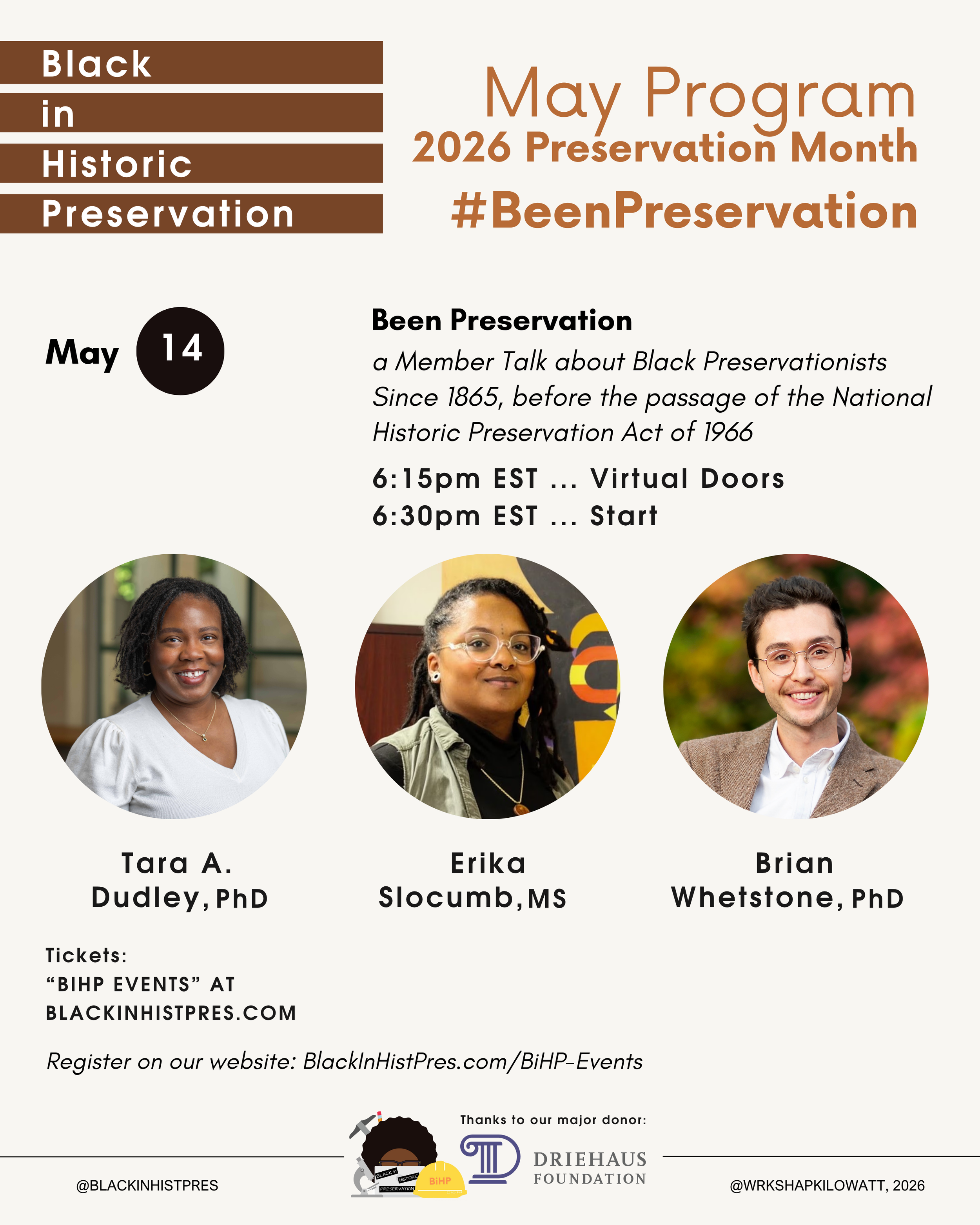
… for a panel discussion about Black Preservationists, dating back before the passage of the National Historic Preservation Act of 1966.
The presentation will raise awareness about specific topics in historic preservation / heritage conservation:
Jim Crow (Early to Mid 1900s)
This event is a must-attend for anyone interested in the legacy of Black people preserving historic sites. Don't miss out on this enlightening discussion!
Panel discussion hosted by Black in Historic Preservation Founder + Program Director k. kennedy Whiters, RA
Panelists’ abstracts and bios:
-
Preserving While Building: Black Women, Memory, and the Foundations of Historic Preservation
Long before preservation was formalized as a field, Black women were foundational preservationists. By the early twentieth century, women such as Mary McLeod Bethune and networks of Black clubwomen had cemented their own systems to sustain community memory, protect cultural landscapes, and build institutions that preserved Black history in the face of systemic exclusion. Notably, their efforts resulted in the preservation of Frederick Douglass’ home Cedar Hill.
Moving beyond a focus on buildings and designation, Dr. Dudley will highlight preservation as a lived practice—enacted through institution-building, archival work, and Black women’s safeguarding of intangible heritage such as oral traditions, labor practices, and community networks. Drawing connections to her research on contemporary work in Austin, Texas, Dr. Dudley will examine how Black women’s labor, particularly in domestic and service economies, shaped both the built environment and the social infrastructures that sustained Black life.
About Dr. Tara A. Dudley
Dr. Tara A. Dudley is an Assistant Professor in The University of Texas at Austin School of Architecture, where she teaches architectural history and interior design history courses. Her research and scholarship engages untold histories and works to demystify the process, paths, and methods of marginalized contributors to the built environment and reassert their historic agency with an emphasis on African American craftspeople, builders, and architects in the US South. Her work reflects an interdisciplinary approach to the study of cultural resources with a focus on nineteenth-century American design, African American architectural history, historic preservation, and material culture. She is the author of the multiple-award-winning book Building Antebellum New Orleans: Free People of Color and Their Influence. Dr. Dudley was a senior architectural historian for Austin-based preservation consulting firm HHM & Associates, Inc. for two decades and continues to lead and consult on preservation projects nationwide. She has served on the City of Austin Historic Landmark Commission and is the current chair of the Texas State Board of Review.
-
Autonomy, Agency, and Authenticity at American House Museums
As private homes transitioned into public historical sites in the nineteenth and twentieth centuries, formerly enslaved Black women and working-class White domestic workers emerged as the first generation of guides, workers, and caretakers who lived in and managed these sites. White site administrators prized these workers as "authentic" links to a romanticized antebellum past and the attendant social and racial hierarchies of a bygone era, making them ideal guides to present such historical narratives to public visitors. But these Black and White working-class women also exercised significant authority in the early administration of these sites.
From their decades of labor cleaning and caring for historic homes, these workers acquired an intimate material knowledge of historic homes, making them significant agents in the early preservation of historic sites. This presentation explores the role of these women in historic preservation practice alongside the material legacies of slavery and domestic work embedded in preservation and public history practices today.
About Dr. Brian Whetstone
Brian Whetstone is an assistant professor of historic preservation in the Department of Historic Preservation at the University of Pennsylvania. A public historian and scholar of historic preservation, his work explores the intersections between housing and labor equity at museums, historic sites, and preservation organizations in the United States. Whetstone’s current research encompasses a manuscript project, Renting History: Housing, Labor, and America’s Heritage Infrastructure which explores the role of renting and the provision of housing at historic sites, museums, and heritage organizations across the twentieth century. Whetstone holds a Ph.D. in History and certificate in Public History from the University of Massachusetts Amherst. Prior to his appointment at Penn, Brian worked as a historian with the National Park Service’s History, Architecture, Conservation, and Engineering Center (HACE) where he coordinated preservation research and documentation projects for national parks in the northeastern United States. He has served as a postdoctoral fellow in the Mellon Initiative in Architecture, Urbanism, and the Humanities at Princeton University and a Research Fellow for the University of Pennsylvania’s Center for the Preservation of Civil Rights Sites.
-
Reliquary of Blackness: Preserving the Story of Mrs. Isabelle (Grimm) Tilley
So much of what has been preserved about Black history has been carried through the stories and artifacts preserved by Black families. Stories that have been passed down orally, written down, and stored away for future generations. This preservation work has been a responsibility that has often been kept in family homes, but has seldom been accounted for in the public realm.
In this talk, I will look at the work of Mrs. Carol Washington in preserving her family history and the way my work at History New England enabled us to collect and publicly preserve the history of Mrs. Isabelle Tilley and over a century of her family's history.
About Erica
Erika Slocumb is a scholar of Black history. She has worked on recovering the history of Black people in Holyoke, Massachusetts, in conjunction with the Holyoke community and the Wistariahurst Museum and most recently working at Historic New England on the Recovering New England’s Voices, interpreting and researching the histories of Black experience across New England.
Her research “Reliquary of Blackness,” focuses on the use of archival research, oral histories, and community storytelling to retell, reshape, and reclaim history in spaces where Black stories have been obscured, specifically reclaiming the narratives of Blackness in museums and other repositories of history and culture.
She is currently the Director of Interpretation at the Stowe Center for Literary Activism, where she uses the legacy of Harriet Beecher Stowe, and her collection, to interpret the history of Black authors and activists who enabled Harriet Beecher Stowe to write 'Uncle Tom's Cabin.'