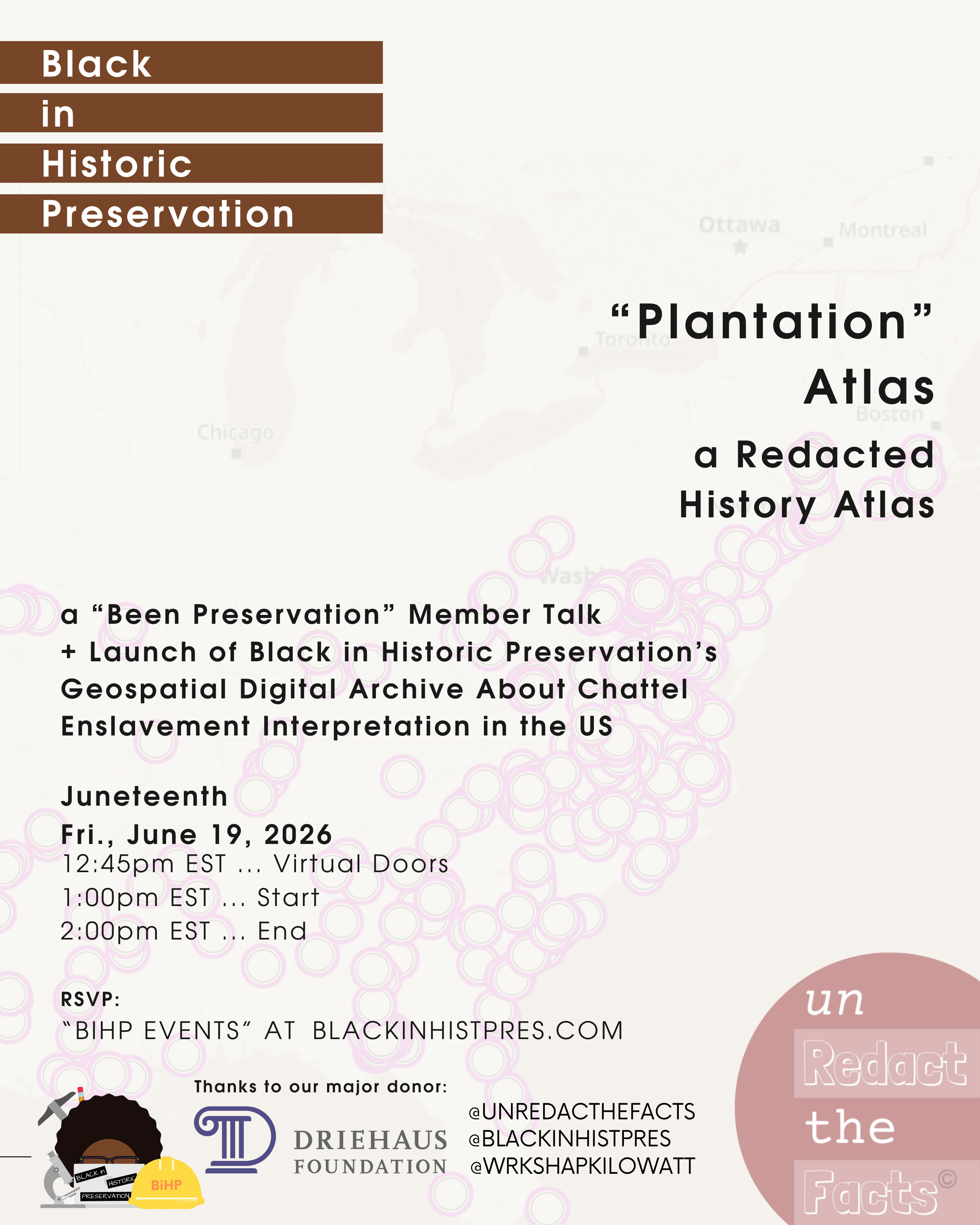
“Plantation” Atlas Launch
The plantation, i.e., forced labor camp, in the United States might be the quintessential building type and cultural landscape associated with the history of Black life in the US and the origin story of the relationship between Black and White people in the country. And yet, this site-specific history of chattel enslavement is:
Not consistently interpreted at the forced labor camps today
Not consistently interpreted at the sites where forced labor camps once stood
Only associated with the North
Not associated with unconventional former sites of enslavement like colleges and universities
Black in Historic Preservation has taken on the challenge to change the above. Introducing, from its Preservation + Belonging Lab research initiative, (un)Redact the Facts:
the Redacted History Atlas.
The first of many atlases to launch from the digital mapping project is the “Plantation” Atlas.
Developed by Black in Historic Preservation Founder + Program Director k. Kennedy Whiters, RA, the “Plantation” Atlas is an interactive map of 1,200+ former forced-labor camps in the US. It maps if and how these sites interpret chattel enslavement as of May 2026.
…
The launch will premiere the first two states with complete, redacted history profiles: Illinois and Arkansas. Yes, you read that right: Illinois and Arkansas. These two states and a few others are not the usual suspects when people think of "plantations" and US chattel enslavement, which makes an atlas like this all the more necessary.
…
Presented by Black in Historic Preservation Founder + Program Director k. kennedy Whiters, RA.
Join us on Juneteenth to learn more about this public resource.
Who is this for?
For preservationists, architects, students, grassroots advocates, cultural workers, historians, archivists, genealogists, people researching their family history, professors teaching historic preservation and allied fields such as archival science and archaeology, and more.
Why is there an admission fee instead of free entry?
Free guides are typically underwritten with large donations. Generally speaking, most things in life that are “free” to the public are not technically free. They are underwritten via a large donation or tax dollars. This atlas is not. Purchasing the guide supports Black in Historic Preservation in practicing one of its core values: Pay Equity. Paying for the guide allows Black in Historic Preservation to compensate its primary author and have funds available for future events and resources. And, for security purposes, we are charging a small entry fee. Thank you.